Preserving historical monuments is necessity in country with ancient past: restoration graduate
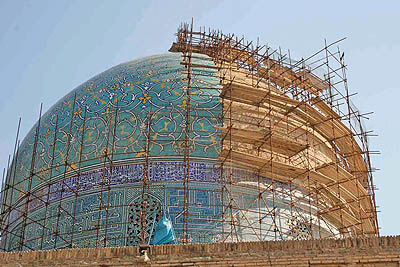
TEHRAN - The appropriate restoration of historical monuments is not a matter of choice but a necessity in a country where every corner contains layers of history, a young restoration specialist says.
Maryam Asgharinia, a graduate of restoration and regeneration of historic fabric and monuments, believes that restoration cannot be learned solely in classrooms.
“Facing a city, communicating with people, understanding regulations, and grasping concepts such as privacy, respect, and professional ethics are integral parts of restoration education,” she said.
Speaking to ISNA, Asgharinia said her education benefited greatly from working alongside experienced professors and participating directly in major projects, including restoration workshops at Golestan Palace and urban regeneration efforts around the Plasco building site in central Tehran.
Asgharinia noted that while curricula approved by the Ministry of Science were not always taught fully or precisely as defined, professors attempted to adapt training to real-world needs through their professional experience.
“At the same time, student motivation is crucial,” she said. “One negative trend in recent years is that restoration has become a so-called ‘floating field’ with declining admission standards. In some cases, students are accepted without entrance exams. This lowers both scientific standards and genuine interest, as some enter simply to obtain a degree.”
“In such conditions,” she added, “even the best professor cannot achieve effective education if students lack motivation.”
Asgharinia then underlined that restoration education should shift toward a work-oriented model.
“From the beginning, students should work on projects that respond to real urban needs,” she said. “This connection with society, institutions, and people helps students understand that restoration is an interdisciplinary field.”
She said students take greater responsibility when they know their work may be reviewed by institutions such as municipalities or local governors. Limiting student intake, she added, would also improve training quality.
“Restoration cannot be separated from urban regulations,” she said. “Students must understand legal frameworks and urban structures so they can enter professional discussions with knowledge rather than idealism.”
She added that the number of qualified consulting engineers and contractors capable of carrying out restoration projects is limited, and the country lacks the capacity to absorb large numbers of restoration graduates.
Despite Iran’s rich cultural heritage, Asgharinia said restoration is often poorly executed due to structural and regulatory gaps.
“In new construction, roles and responsibilities are clearly defined,” she said. “But in restoration, there is no such clarity. Anyone can claim to be a restorer without specialized training.”
She said even in Tehran’s Grand Bazaar, much restoration work is carried out by non-specialists who treat historic buildings as ordinary renovation projects.
She said the Ministry of Cultural Heritage should address this issue in coordination with the engineering system.
Another major gap, she said, is the lack of dedicated restoration supervisors. “In practice, supervision is often symbolic,” she said. “Supervisors are not continuously present on-site and have limited responsibility for materials, execution details, or unexpected findings.”
She said safety oversight is also inadequate, as restoration projects are often excluded from standard engineering and fire safety supervision.
“If a historic building catches fire, it is unclear which institution is responsible,” she said.
She cited Tehran’s Grand Bazaar as a clear example of institutional deadlock, where fire safety warnings, heritage protections, and property ownership issues conflict, leaving buildings and owners in limbo.
A message to future restorers
Reflecting on her journey, Asgharinia said she would advise young restorers to see themselves as representatives of history.
“The city and its buildings speak to you,” she said. “You understand value and authenticity. You are the trustee of history.”
“You are not just preserving bricks or alleys,” she said. “You are preserving moments in history.”
KD/AM
Leave a Comment